Saturday, November 17, 2007

Food for Thought

What are my passions? What do I really care about in this world? These are questions I have been thinking about a lot today. Lately I have been drawn to writing and thinking and away from the siren song of the television and even the Internet (gasp!). But about what should I write? What should I read?

I am inexplicably drawn to books about writing and food, New Testament Greek and spiritual theology. Bizarre, I know. If someone wrote a book regarding insights into the Incarnation and peanut butter cookies, or how coq au vin illustrates the sacrifice of Christ, or parallels between red wine and the Lord's Supper, I would be ALL over it. I'd be up to my elbows in peanut butter, raw chicken, Beaujolais and the gospel of John. Bizarre, I know.

So tonight's meal begins with this great red cabbage recipe, topped off with some bockwurst that I brought home a couple weeks ago. Sort of a spin off of a dish our mothers used to make with red cabbage, smoked sausage and potatoes, sans potatoes. Our world here has been chock full of potatoes lately.

This is what it looked like a couple hours into cooking...


So what does that have to do with theology? I honestly don't know. What I do know and believe is that whether it's red cabbage and bockwurst or chicken or peanut butter, God is found in the particulars, in the real and tangible and relational parts of our lives. As Eugene Peterson writes in his book, The Jesus Way, “The gospel is not an idea or plan or a vision: it works exclusively in creation and incarnation, in things and in place” (Peterson, pg. 189). And maybe that's what this meal points to, that in the simplest, earthy places, molded and formed and chopped and stuffed and soaked through and sent through the fire, that what comes out in the final product is not just a mish-mash of tastiness (or not), but from beginning to end is part of God's creation and means through which that creation can be transformed.

I believe that is God's way with us too.

What connections do you see? Let's hear in the comments.

Tuesday, April 24, 2007

RKT2 - On the way to May...

May is almost here and in the words of Vivaldi's Four Seasons, "Spring has sprung and joyfully the birds welcome it with joyful song." Except it has not been very joyful. Finally exiting the depths of Lent into the bright light of Easter, I had hoped that the spring would be different. But now crushing May in its tragic grip are two events. One, the devastating tragedy at Virginia Tech University in which 32 young people were killed needlessly by a lone gunman. On the the other side, will be our somber remembrances on Memorial Day weekend, of loved ones who have died and those men and women who have given their lives for our freedom in years past and in the current conflict in Iraq and Afghanistan. It is hard to be joyful when we are so surrounded by reminders of violence, human brokenness and betrayal and our own mortality. That Easter happiness seems so far away.

For me, Easter is also where our hope must lie. I remember that before that first Easter long ago, the same deep reminders of violence, human brokenness and betrayal and their own human mortality haunted Jesus' followers. My hope, indeed our hope cannot and should not be in our own ability to vindicate violence, to banish betrayal or destroy death. The Easter promise is not that we have the power to defeat these. The Easter promise is that God does, but not in the way that we want. The Easter promise is that in the life of Jesus Christ, God enters our world, God gifts forgiveness and God creates new life out of the depths of death.

The same is true now. Jesus is alive and that life continues among us. In that life God even now enters those places of violent, hopeless, betraying death whether in Virginia, in Iraq, in Afghanistan and among us. Even now God gifts forgiveness. And our call to faith, is to wait and watch for that surprising Easter moment. When God calls life out of death even today, we are called to run to the empty tomb and welcome it in joyful song.

Tuesday, March 27, 2007

RKT2 - Teenagers...sheesh!

This past week I have had family visiting from out-of-town, among them a twelve-year-old girl, Kim. Most of the time she has such enthusiasm, it is infectious. So many things are new for her, it is a joy to witness them through her eyes and to hear about what she sees. Often, she sees things that I've missed for almost four years. Amazing.

Then there are those other times - the ones about which parents would shake their collective heads knowingly. Meltdowns over missing french fries. Pouting over unfamiliar foods that they insisted that they liked but somehow did not match their expectations. Anger about being corrected on a crowded bus that NO one cannot hop to a different seat every other stop. And the seemingly quintessential question, "Are we there yet?"

While I work with teenagers a LOT, it's a little different being the surrogate parent for one, 24/7, at least for a while.

I now have some deeper sympathy for Mary and Joseph in this passage from Luke chapter 2,

Now every year his parents went to Jerusalem for the festival of the Passover. And when he was twelve years old, they went up as usual for the festival. When the festival was ended and they started to return, the boy Jesus stayed behind in Jerusalem, but his parents did not know it. Assuming that he was in the group of travellers, they went a day’s journey. Then they started to look for him among their relatives and friends. When they did not find him, they returned to Jerusalem to search for him. After three days they found him in the temple, sitting among the teachers, listening to them and asking them questions. When his parents saw him they were astonished; and his mother said to him, ‘Child, why have you treated us like this? Look, your father and I have been searching for you in great anxiety.’ He said to them, ‘Why were you searching for me? Did you not know that I must be in my Father’s house'"

Jesus, a precocious teenager, who wanders off in the middle of a family vacation. With the swaggering voice only an adolescent can muster, he turns attempts to pin the blame on his parents, how could they not known where he would be? Seriously, Mom, like you didn't know. DUH!

If we take seriouly that God was present fully and specially in Jesus Christ, on the one hand, it's hard to take this passage to heart. However, on the other hand, despite all we might be tempted to believe about teenagers, if God indeed was once a 12-year-old, then God too understands them and their mood swings and their pouts and doubts and tears. God knows and loves each and every teenager just as they are, even when they're driving us CRAZY.

God please help me remember!


Tuesday, March 13, 2007

RKT2 - The Banality of Betrayal

When we think of betrayal, we usually think of something quite dramatic and sinister. But, for me, betrayal is something a little bit more mundane. It was the summer when I was 15 years old that I betrayed my father. We had packed up the car in preparation for a mini-family vacation to King’s Island, my favorite annual amusement park experience. While my spirit and my nose were dreading a two-hour car ride with my brother and his stinky feet, my heart was already thrilling with visions of rides on the Beast, the Racer and the Vortex. My father had just gone outside to pull the van from the garage into the driveway when the phone rang. I answered, “Hello?”

“Is Larry Doty there?” the voice in the receiver said.

“Who is it?” I asked.

“This is Eli Lilly,” the voice answered. My father’s work. Being a high-voltage electrician, my father was infrequently called to manage some electrical crisis at one of their several plants in Indianapolis. Simultaneously my heart sank and my mind raced. This was our family vacation, how dare they call him to work when he was supposed to be on vacation.

My father walked in the door. Should I tell them he was here, I thought to myself, and risk losing our trip? I knew my father was just as excited about the trip as I was. “He really was on vacation, which was almost like being away,” the little voice in my head said. If I say he’s gone, then we can just leave for our trip and no one has to know.

“He’s not here,” I heard myself say. Perfect.

Then from the kitchen came my dad’s voice, “Who is it, Kevin?”

“It’s your work,” I replied.

He had heard my lie. And he knew. I felt ashamed and embarrassed and vile. My father knew and he simply glanced at me as he took the receiver from my hand, saying, “This is Larry.” In that moment I had betrayed his trust and the values of honesty and hard work that he had taught me. It wasn’t the first betrayal nor the last, but it was for me the most memorable.

We are all experienced betrayers - those mundane but somehow central moments when the facades we build around ourselves suddenly come crashing down and our affinity for the enemies of our lives, enemies like selfishness, greed, ambition and pride, become painfully visible to the rest of the world and to us.

My betrayals are all too frequent and too mundane and unfortunately often they are also too true.

As we continue in this season of Lent, I have been pondering the betrayal of all of the disciples, but especially Judas. I think while our hope is that we are more like Peter, denying Christ, but ultimately being forgiven, our deepest fear is that we are each a faithless Judas. We have willing been betrayed by our own anger and succumbed to violence, been betrayed by our loneliness and sought quick passions, been betrayed by our own helplessness and anxiety and fear and covered them up with intoxicating substances or pushed them down into the deepest recesses of our spirit hoping they never return.

But the good news of the gospel, for Judas and for us, is not that we will never be betrayers or denyers or deserters of our professed faith. The good news is that its not our faith that saves us who makes us right with God. It is not faith in Jesus Christ but the faith of Jesus Christ that matters.

Tuesday, March 06, 2007

RKT2 - Seeing the Stranger

When I was in school, I always had mixed emotions about teachers who thought they knew who you were because they happened to know your family. My dad and especially my grandmother had unintentional hidden networks throughout the school. Twenty-three years prior, my dad had graduated from the same high school I attended, while my grandmother had worked for the school system for many years as both a custodian and as a 'lunch-lady' back when 'mashed potates' on the menu meant that they had actually peeled and diced and cooked and mashed real potatoes. Every year it seemed at least one teacher would say, 'Are you Larry's son?" or "Are you Stella's grandson?"

"Yes," I would grudgingly reply, unsure what conclusions the questioner was making about my background, my intelligence or my personality. It felt like instead of seeing me, a bright new shining face in front of them, they actually saw me only through a hazy vision of my family.

The positive side is that I'm the oldest; my little brother had to bear being compared to Grandma, Dad and me.

I've done a lot of thinking lately about hospitality and how we practice it, as a community of faith and as persons of faith. To practice hospitality means that we actually see and interact with whoever comes to us. To practice hospitality means that instead of trying to figure out what boxes or categories we can fit someone into, we meet them where they are and respond to their needs as they are. To practice hospitality means the hungry get fed, the weary get to rest, the sick get healed and those who are bound get loosed. What is radical about this hospitality, God's hospitality, is that whether we are the guest or the host, we come to the table as equals, as fellow creatures and both are blessed.

But it's more than that. Hospitality, like all true Christian practices, is such because it molds us in the ways of God. For God comes to us as one who is completely other. God comes to us as a stranger, who cannot be put in a box or category of our choosing. God comes to us as a completely free person and asks us to respond. When we practice hospitality to the human strangers before us we learn to see, hear, touch and respond to the divine stranger.

Sunday, March 26, 2006

Living in a Junk Shop

"Junk" is such a harsh word. Few people think of junk as a positive description of anything. Ever drive by a junkyard? Piles of worn-out, rusty automobiles, shattered TV tubes, mounds of decomposing diapers. Not attractive. Even calling it a landfill only makes it sound slightly less appealing. We can cover it up with soil, puncture it with PVC piping and plant grass on it, but in the end its still a pile of junk.

We all create junk. Just think about your most recent meal. Mine was breakfast. As I deftly and almost mindlessly began heating the teapot and preparing my meal, I suddenly noticed that I kept moving back and forth between the counter and the trash can. One piece of trash for my empty Sweet-and-Low packet. One piece of trash for my instant oatmeal wrapper. Yet another piece of trash for my chamomile tea bag holder. Three pieces of trash, for a monastic breakfast. And I am just one person. Multiply that by three meals a day and over 280 million people in the United States alone and you begin to sense the ecological issue we face.

I grew up hearing the phrase, "God doesn't make junk," especially people. A profound theological point and certainly true in my opinion. We sang our little prepubescent hearts out for a whole week one Vacation Bible School musically making this point. Maybe its easier to remember or easier to see when you're twelve. God doesn't make junk and you've only had eight years or so to start screwing it up.

The San Francisco Chronicle carried a heart-wrenching article yesterday titled, "A homeless beauty and the beast, heroin" describing the tragic life of Rhonda Bye, a Washington state girl, her beauty confirmed by modeling jobs and her brains clear from her technical work on computers for a part-time employer. She dropped out of school, married young and tried cocaine. Cocaine led to a heroin and crack addiction. Her beauty withered. Her intelligence faded. She became yet another undesirable person under the freeway; one holding a cardboard sign emblazoned, "Dreamin of McDonalds," asking for another handout.

Looking at Rhonda's picture as a young girl, you realize that she's not any different from those other kids that were on that church stage, singing and knowing that "God doesn't make junk." Yet Rhonda chose to live as if her body was a junkyard. Take in the worn-out, rusty, shattered mounds of decomposing trash, one hit, one cube, one vial at a time.

We are no better. The trash we accept may be different, but the junkyard attitude is the same. Another order of fries, a cigarette, that third cocktail, add on the trash, just make sure we cover it all up with a little soil and some flowers. We convince ourselves that at worst we are living in a landfill and for that matter, its ours and we can do what we want with it, thank you very much.

Rhonda died of kidney failure this past Wednesday at age 39. If we're even half-listening, Rhonda wakes us up. Rhonda reminds us that we are not our own. Rhonda reminds us that we are only one or two strategic pieces of junk away from the path she trod.

How would we live if we still believe that God doesn't make junk? How would we live if we remembered that we occupy not a land fill of our own making but a temple to the LORD?

Friday, March 17, 2006

All joking aside... church fires?

Humble reader,

I must first address you before launching into my latest musings. Thank you for your patience. I confess that I have thought much more in the last three months than clearly I have written. For that I apologize. Now, without further ado...

On March 16, the New York Times reported an update concerning a string of nine church fires in Alabama. Three college students have been arrested in connection with setting these fires. While, I admit some amount of cynism, what struck me was not the fact that three young white men are charged with torching multiple small black churches. The article notes, with some surprise, that the accused came from good families (insert shock) but that hunting and copious amount of alcohol consumption was involved (insert tsk-tsk and shake of head). What struck me was their self-confessed reason, saying that they,
"'had done something stupid' and that they set fire to a church 'as a joke.'" (emphasis added)
I think we can let lie the standard "alcohol+hunting=stupid boys" diatribe. But how exactly do we get from complete stupidity to the offered explanation, which clearly one of the accused, thinks is somehow a rational reason for setting church fires. He is not saying, "We were so drunk that night we just got carried away," nor is he saying, "We were out there hunting and decided to start a fire to keep warm, and it got away from us." He is claiming that the impetus to burn down a place of holy worship, and a place of fellowship for a community of faith was a "joke."

A joke? On one hand, we could simply write these boys off as at best stupid and at worst insane. But what if we assumed that their reasoning really is that this is a 'joke'? How could someone rationalize such a position?

Humor is contextual. We all know that a joke can be gut-busting hilarious with one group of friends and a complete flop with a different group. Humor then is not just individual; it is also communal. While these young men must rightly be held personally responsible should the allegations be proved; we must also question ourselves. While these young men's families, friends and communities distance themselves from such violent and destructive acts, it is easy for us too to take a down-the-nose glance in their direction. However, if indeed this is a 'joke'; then we ourselves must search both internally and in our respective communities for the ways in which the shared context of our lives might unintentionally or otherwise be read not just as implicit permission of such acts. Even worse, what if the way we live sent the message that we would explode with out-loud, boisterous gales of laughter while the black church on the corner flamed, crackled and burned into the ground.

All joking aside... what if we were the ones who made the joke?

Tuesday, December 13, 2005

Tookie It Away

At 12:01 a.m. PST, Stanley 'Tookie' Williams, founder of the Crips gang and convicted murderer, was executed at San Quentin prison by the State of California.

Perhaps elsewhere, but certainly here in California, Tookie's (as we affectionately know him) multitude of appeals, requests and legal manuevering have made headlines all week. At each turn, not only was Tookie denied, but it was also an opportunity for us to hear yet again about Tookie's rehabilitation, Tookie's children's books and Tookie's work against gang violence. The nightly news even had a helpful hour-by-hour description of Tookie's last night among the living, which began to sound like the outline of a reality TV show. And of course, all the forces arrayed to keep 'law and order' had their say, including a haggard looking woman for whom the death of her son seemed to have happened yesterday, not 27 years ago.

According to his supporters, Tookie had "redeemed" himself with his activist work against violence. However, according to the news report, "In denying clemency, Schwarzenegger said Williams had failed to atone for his crimes, and questioned whether claim of redemption was just a ploy."

Redemption. It seems that by redemption most of these people mean something closer to contrition, that Mr. Williams confessed his crimes, was truly sorry, that he repented and turned from his former violent ways. And contrition is what we want. Through the state, we citizens want men like Tookie to feel our anger and our outrage. We want him and others death-row inmates to approach the throne of civic justice, where of course we all sit, grovelling, head-down and cowering before our righteous power where we alone, through our duly elected leader, dangle by a thin thread this murderer over the fiery pit of his just reward. We want contrition. We want justice.

Redemption on the other hand is none of these things. To be redeemed means to be acted upon in a way that you would never be able to accomplish yourself. To be redeemed means to be saved, not by your own power or action or will, but by another. To be redeemed means not that you accomplish your own salvation but rather you respond to the gift of salvation that has happened to you.

So then was Tookie redeemed? Could a man who grew up in violence, created and sustained a community of violence and who himself murdered four people could such a man save himself? Could such a man find himself writing children's books? Could such a man speak out against the man he truly was? Or was he redeemed from outside himself to be transformed, renewed and saved?

And what of Tookie's execution? Does more killing lead to redemption? For his victims? For their families? For former gang members? Does killing another human being redeem us? The governor? The courts? Does killing one m0re person have the power to transform us, to renew us, to save us, to redeem us?

If what we seek is truly redemption, then even in death, Tookie Williams may have found his redemption.

Thursday, December 01, 2005

World AIDS Day

Today, December 1st is World AIDS day. I know; I forgot too. If you were around in the 80s, you remember what a huge deal AIDS was back then. Even though I was in middle school, I was scared. The teenage hemophilliac who contracted AIDS from a blood transfusion, Ryan White was only a year behind me in school. Kokomo, Ryan's hometown, is only an hour from where I grew up. AIDS was not well understood at the time and he had been forced to study at home because parents were afraid their kids would catch it. When courts temporarily allowed him back at school, Ryan had to use a specially secluded bathroom and eat with disposable utensils in the school cafeteria. AIDS was scary for kids and scary for adults.

Celebrity AIDS cases, a myriad of enhanced drugs and education about risk factors for HIV/AIDS turned this once death sentence killing millions into a disease with which millions lead otherwise normal lives.

It is too easy to forget. Too easy to forget Ryan. Too easy to forget people who suffered horrible, lonely and painful deaths. Too easy to forget communities and familes whose lives overflowed with grief and loss. Too easy to forgot those red ribbons we once wore so courageously and defiantly.

Not today.

Today let us remember.

Friday, November 25, 2005

Black Friday

Today we woke up to the day known as "black Friday." After a wonderful Thanksgiving filled with good friends and Ronnie's beautiful decoration of our home for Christmas, "Black Friday" certainly does not do justice to the good feelings of yesterday. As I groggily sipped my morning cup of coffee, the TV news overflowed with reports of the day's shopping frenzy. In one particularly depressing case in Floriday, two shoppers were arrested after coming to physical blows when supplies ran out of a particular gift item.

So often we opine that others have forgotten the 'true meaning' of Christmas. We proclaim to anyone within earshot that those people clearly don't understand that Christmas is about joy and peace or we quip that the abbreviation Xmas takes the "Christ out of Christmas."

While we ourselves may not be fist-fighting in Walmart or Target, we are 'those people." We will write out our lengthy Christmas lists. We will ask every family member, "what do you want for Christmas?" We will scour websites and stores and malls for yet another year's attempt at the "perfect gift." For what? To show off our wealth? To make our family or friends like us better? As a replacement for forgiveness or as a dose of guilt? We have met the enemy, and they are us.

Yes, the wise men brought gifts of gold and frankincense and myrrh to Jesus. If we truly want to have Christ in Christmas, we need to remember that Christ isn't a gift to be given, Christ is a gift to be received. This holiday season, let us be open to receiving, to recognizing and giving thanks for the rich blessings that are already ours.

Express joy. Practice peace. Live in love.

The best gifts for Christmas.

Thursday, November 24, 2005

Turning to God in Thanksgiving

When we imagine the 'first Thanksgiving' our minds turn to the classic image of dour Pilgrims gathered around a turkey in prayer. However, the first national Thanksgiving holiday was not instituted until 1863 by President Lincoln. Lincoln had been urged by Sarah Joseph Hale, the spirited writer and editor of that era’s most popular women’s magazine Godey’s Lady’s Book. As early as 1855, Mrs. Hale urged on her readers and the elected officials to create a national day of thanksgiving, the last Thursday of November. This day would celebrate the prosperity and growth of the United States, honor the work and industry of the people, and, according to an 1860 editorial by Mrs. Hale, promote, “the perpetual political union of the States.” Less than a year later, the American Civil war began.

In his proclamation creating the holiday, in the midst of the Civil War, Lincoln called on the nation to observe a day of repentance and thanksgiving.
“It has seemed to me fit and proper that [our blessings] should be solemnly, reverently and gratefully acknowledged as with one heart and voice by the whole American people. I do therefore invite my fellow citizens in every part of the United States, and also those who are at sea and those who are sojourning in foreign lands, to set apart and observe the last Thursday of November next, as a day of Thanksgiving and Praise to our beneficent Father who dwelleth in the Heavens. And I recommend to them that while offering up the ascriptions justly due to Him for such singular deliverances and blessings, they do also, with humble penitence for our national perverseness and disobedience, commend to his tender care all those who have become widows, orphans, mourners or sufferers in the lamentable civil strife in which we are unavoidably engaged, and fervently implore the interposition of the Almighty Hand to heal the wounds of the nation...” (emphasis added)

President Lincoln as he called a whole yet fractured nation to celebrate that first national holiday of thanksgiving, urged a nation to do so with penitence, that is repentance. For a nation deeply divided by war, political power, regional economics, a sense of unease about the future, and the death of family members in combat, Lincoln called a nation to both repentance and thanksgiving.
Repentance is a return. Repentance is not a dreary self-flagellation mulling over our myriad motives and mistakes. In Greek the word literally means, “to turn around.” In repentance we stop and do an about-face, a complete 180 degree shift of movement, of perspective, and of focus. Repentance challenges us to perhaps turn our whole lives but more likely to turn our priorities, our views or our relationships. Repentance means a return, not to fun or sadness or loneliness but a return to God.
In November of 1857, Sarah Hale in another editorial wrote that to celebrate Thanksgiving is a “return...to the gayeties of childhood... when the noise and tumult of worldliness may be exchanged for the laugh of happy children, the glad greetings of family reunion and the humble gratitude of the Christian heart.”
Thanksgiving, like repentance, is at its root a return. For some today is a return to the memories of childhood, a return to the warmth of family and home, a return to the simplicity of cherished traditions and favorite recipes. For others today is a return to memories of trusts broken, to the pain of family shattered, to the loneliness of faces that no longer grace our tables or our lives. Thanksgiving is a returning.

Of course, it’s important to know why we are turning. Every year at Easter, there is a church that practices an odd ritual in turning. After a rousing trumpet fanfare the congregation in unison faces the large rose window at the back of the sanctuary and turns its back on the 50 voice choir standing proudly on the chancel and their beautiful rendition of Handel’s famed Hallelujah Chorus. As long as anyone can remember, turning around has been the tradition. Few people know why they are turning around they just do. Only one old parishioner was able to explain...”well,” he said, “we turn around because in the old days the choir was in the back.” It’s important to know why we are turning around.
When we repent, we remember that it is not through our effort, but God’s work that protects us, God’s work that provides for us, God’s work that sustains and even disciplines us on our journey together. When we turn toward God, we too come to the place where we can recognize God’s blessing and bless God in return.
True thanksgiving comes from repentance, remembering to whom we owe our blessings, even our whole lives.

In the children’s classic The Giving Tree, a boy grows up loved by a tree. The boy would visit her, play with her leaves, climb her trunk, eat her apples and nap in her shade. As the boy grows older he goes away, only returning throughout his life to take blessings from her - first her apples to sell, then her branches to build a house and finally her trunk to make a boat. The tree willing showers these blessings upon the boy, but each time it is not enough to make him happy. Each time the boy presumes that the tree will bless him, because of her love for him.

In the last scene of the book, the tree welcomes the boy, now and old man, saying, “I am sorry, Boy, but I have nothing left to give you.” The boy answers that now he is old, he only needs a place to sit and rest. The tree offers the only thing she has left, her stump. The boy sits. “And,” the story says, “the tree was happy.”

Each time he returns, she does bless him. But both are blessed when as an old man, the boy returns to her, content to sit on her stump and rest in her presence and thankful for the gift, not yearning for more.
Today, as we celebrate the bounty and blessing that surrounds us, we can rest in God’s presence, thankful for the gift of life and the abundance that has been showered upon us. We can turn toward God and remember to whom we owe our lives. We can turn toward God and remember our God who has protected and provided for us, who has sustained and saved us. We can turn to God in thanksgiving.

Friday, November 11, 2005

Advent Time

If you’ve been anywhere near a church in the season of Advent, you have most likely have heard that, “’Advent’ means ‘coming.’” Advent traditionally begins the fourth Sunday before Christmas and is supposed to be a chance for us to prepare ourselves for the celebration of the coming of Christ into the world as well as Christ’s future second coming. But for me, to simply define Advent as ‘coming’ lacks the power to get me out of the consumeristic whirlwind already underway at Hallmark, Starbucks and the Galleria.

More simply Advent is the time that separates us from when we mark our awareness of Christmas’ coming and the actual event. Time is the operative word, for our modern sensibilities seem to have but one mode for time, now. Whether it’s our desires, our goals, our relationships or even our latte order, we want it now. And if not now, at least as quickly as possible. The mere existence of FedEx points to our obsessive desire to shrink the span between the time our need is realized to the time it is filled.

The Greeks, obsessive about their use of language, had two different words for time. The first, ‘kronos,’ referred to human, measurable time. Our modern minds deal almost exclusively in the realm of kronos. How long does it take? How many days till Christmas? And how can I get my package there faster? Kronos time.

But the Greeks described another kind of time, ‘kairos.’ Kairos time means the fullness or the ripeness of time. We talk about time that way when we say something’s “time has come.” Kairos time is God’s time. Kairos time is not time that we measure. Kairos time is not something we can shrink or stretch. Kairos time is time in which we patiently watch and wait. Kairos time is when we work steadily in the fields, preparing for the harvest that will come only on its schedule, not ours.

Advent is not lived in kronos time. Advent should not be about counting down the days, or trying to control whether the time goes slowly or quickly.

Advent is kairos time. In Advent’s kairos time, we too patiently watch and wait. We work steadily, anticipating, not controlling, the harvest. Only if we live Advent in kairos time will we receive God’s Christmas gift, ripened to perfection.

Tuesday, November 08, 2005

Intelligent Design?

Today, the Kansas Board of Education approved new science stardards which attempts to poke holes in the theory of evolution. At the behest of a misguided religious right who neither understands the roots of the scientific method nor the implications of theology, six Republican board members outvoted their four colleagues to draft the new standards. The new standard states that basic evolutionary concepts must be understood by students but that recent biological research has questioned Darwinian assertions that all life started from a common origin and arose from natural chemical and biological processes. This opens the way for other ''alternative" explanations to be taught such as "intelligent design" which asserts that life is so amazingly complex that a "higher power" must have been responsible.

Now, let us put aside for the moment that while the theory of evolution cannot be tested directly, the scientific assertions that underly Darwin's naturalistic insight remain one of the bedrocks of modern evolutionary biology not to mention many other scientific disciplines. And, I suppose we can even put aside the dangerous theological problems of asserting that just because we do not fully understand some things about the nature of the beginnings of life, someday we might, closing God out of yet another sphere of authority, because we chose to stuff God into that lone sphere in the first place.

No, I think the most cogent argument against "intelligent design" is a theological one. While advocates of this view conveniently like to refer to their 'intelligent' higher power, the Bible in no place talks about a 'higher power." The witness of the Bible, to which these Christians ostensibly subscribe, is not to a nameless higher power, a faceless behind-the-scenes figure that somehow sticks a finger into the mirky soup of existence to tweek an atom here, a molecule there, to make the glorious creation that is our universe and of course, the potently proud humankind.

The Christian faith asserts that is God, the LORD, Yahweh of the Old Testament that created us. The Christian faith asserts that this God is a God we know by name, a God who knows us by name. The Christian faith proclaims our God that cares so deeply not just about us but about the whole of the created universe that this God came to us in a human child, a baby that grew into a man - a man with a face, with hair and hands and feet and eyes and a name; Jesus Christ.

Intelligent design is not only unscientific.

It's un-Christian.

Saturday, November 05, 2005

Risk Heresy!

Several years ago, a mentor charged me at my ordination to ministry, to "Risk Heresy." As I've witnessed the ongoing polarization of this country around concepts of religion and specifically Christianity, this brief charge has been a guiding principle to me as I think through faith and attempt to lead a life of faith myself.

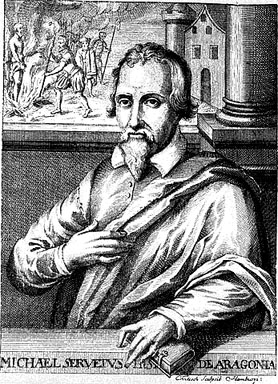
Michael Servetus, above, risked heresy, and struggled against John Calvin.
Servetus also ended up burned at the stake. No one said heresy was easy.


To risk heresy, we must be willing to admit we do not in ourselves have all the answers.

To risk heresy means we must humbly encounter others who have challenging ideas about what God is up to in their life and lives together.

To risk heresy means that we must open re-examine and re-explore our own beliefs and ideas.

To risk heresy reminds us that our faith is not equal to our limited construct of our understanding of the faith.

To risk heresy forces us to remember that ultimately it matters less what we have to do with God than with what God has to do with us.